What it takes to move an AI agent from prototype to production
A convincing demo takes a week. A dependable agent that touches real systems takes evaluation, guardrails, observability and an owner.
Key takeaways
- Narrow, well-defined jobs reach production far sooner than general assistants
- Give agents scoped tools, read-only first, through a consistent protocol such as MCP
- Evaluations built from real cases are the only way to know a change helped
- Human approval for high-impact actions builds the trust to automate more
Most AI agent projects stall in the same place: the prototype impresses in a meeting, then nobody is willing to let it act on real customers or real data. Closing that gap is mostly an engineering problem, not a model problem.
1. Narrow the job
Agents that do one well-defined task, such as triaging a support ticket, reconciling an invoice or drafting a reply for approval, reach production far sooner than general assistants. Define the inputs, the allowed actions and what “done” looks like.
2. Control what it can touch
Give the agent tools with explicit permissions rather than broad access. Protocols such as the Model Context Protocol (MCP) make tool access consistent and auditable, and let you grant read-only access first and write access later. Our MCP development team builds these servers for business systems.
3. Measure before you trust
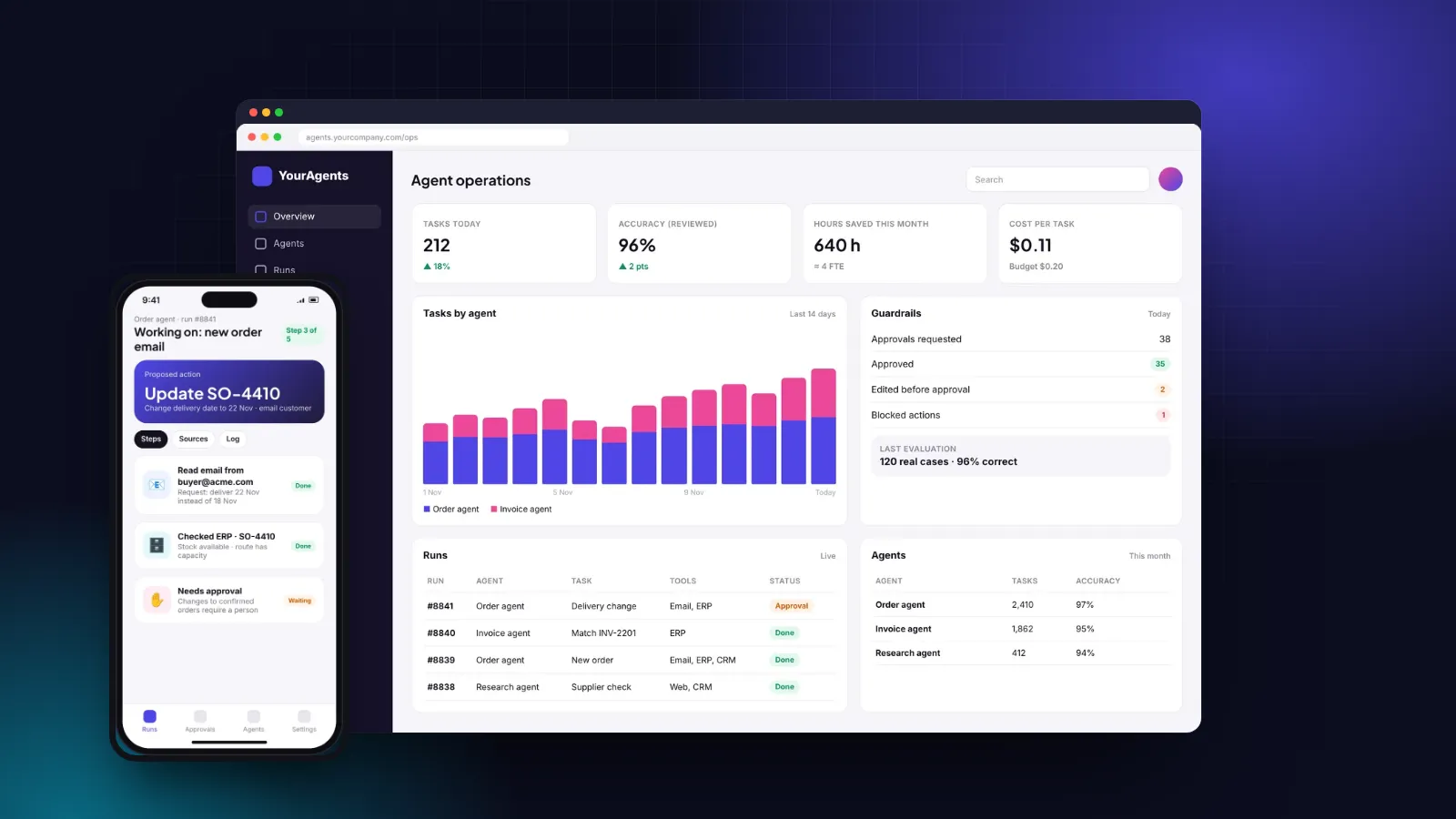
Build an evaluation set from real cases, including awkward ones, and score every change against it. Without evaluations you cannot tell whether a prompt or model update made things better or just different.
4. Keep a human in the loop where it matters
Route low-confidence or high-impact actions to a person. Approval queues are not a sign of failure; they are how teams build the confidence to automate more. In healthcare, for example, Citrus Oncology uses agentic AI to help care teams while specialists stay in control of decisions.
5. Make it observable and durable
Log every step, tool call and decision. Run multi-step work on durable workflows so a timeout or deploy does not leave a task half-finished. Watch cost and latency alongside quality.
6. Give it an owner
Production agents need someone accountable for their behaviour, just like any other system. The best results come from small, multidisciplinary teams, with AI, backend, data and QA engineers working with the business owner, rather than a lone specialist. That is the idea behind our AI engineering teams.
Where to begin
Pick one process where people copy data between systems or answer the same questions every day. Build an agent for that single job, with evaluations and an approval step, and measure it against today’s baseline. Explore our AI Agent Solutions and Workflow Automation, or talk to an AI engineer.
Put this guide into practice
Frequently asked questions
What is an AI agent?
Software that uses a language model to plan and take steps towards a goal, calling tools such as databases, APIs or other systems along the way.
Why do AI agent projects stall after the demo?
Usually because there is no evaluation, no control over what the agent can touch and no clear owner, so nobody trusts it with real data.
What is MCP?
The Model Context Protocol, an open standard for connecting AI assistants and agents to tools and data with consistent, auditable access.
Do AI agents replace people?
In production they mostly take on repetitive steps and prepare work for people to approve, especially where actions are high-impact.