Hire AI engineers or build an AI engineering team? What US companies should know
Missing one or two skills? Hire AI engineers. Missing data, MLOps and evaluation too? Bring in a ready AI engineering team. Here is how to decide, what drives cost and what to own in writing.
 Azad Haider UsmaniFounder & CTO, Appsums
9 min read
Key takeaways
- Hire AI engineers individually when your team already ships to production and lacks one or two skills
- Bring in a ready AI engineering team when data, MLOps and evaluation are missing as well
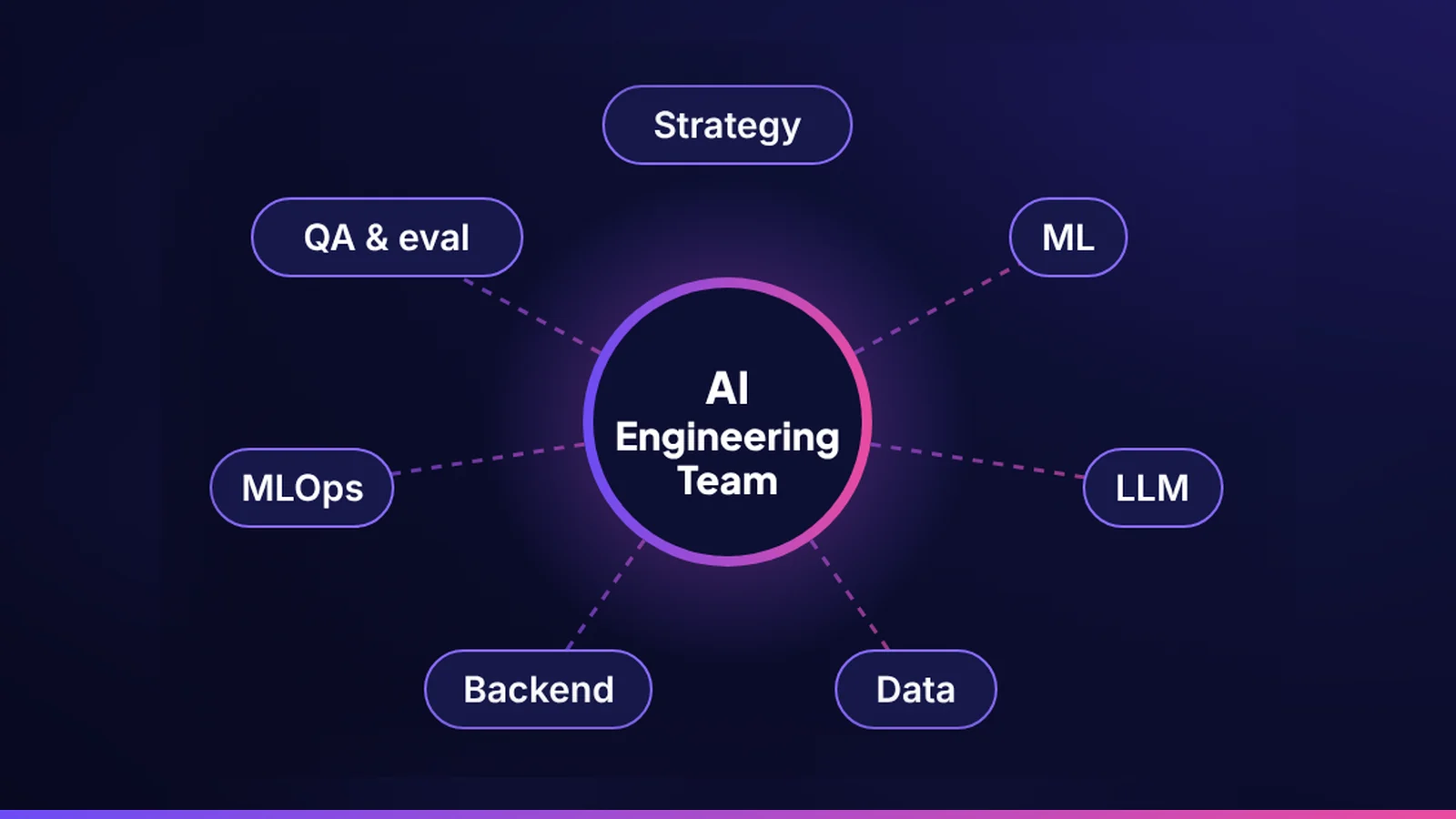
- Every production AI system needs strategy, ML, LLM, data, backend, MLOps and QA work done by someone
- Compare proposals on seniority mix, data readiness, model spend and evaluation work, not a single rate
- Own the models, prompts, evaluation sets, pipelines and code in writing
If you need one or two specialists to add AI features to a product your team already runs, hire AI engineers individually, either in-house or through staff augmentation. If you need to take an AI use case from idea to a tested, monitored production system and you don’t have data, MLOps and evaluation skills in house, bring in a ready AI engineering team. Building a full AI team in-house pays off only when AI is core to your product for years and you can absorb months of recruiting.
That’s the short answer. The rest of this guide is for US CTOs, founders and product leaders who have to make the call: which roles an AI product needs, what drives cost and time, who should own what, and what to check before you sign.
What’s the difference between hiring AI engineers and bringing in an AI engineering team?
Hiring AI engineers means adding individuals. They join your team, follow your processes and your engineering lead directs the work. It works well when the rest of the delivery system already exists: product management, backend, QA, release process and someone who can review AI work.
An AI engineering team is a unit that arrives with the roles needed to ship an AI feature end to end. It covers the use case, the data, the model work, the integration with your product, testing and monitoring. You set the priorities. The team brings the missing skills and an accountable lead.
The difference matters because most AI projects don’t fail on the model. They fail between the demo and production: no evaluation set, no owner for data quality, no monitoring, nobody watching cost per request. If you hire one strong LLM engineer into a team without those pieces, that engineer ends up doing four jobs, or the project stalls after the prototype. We wrote about that gap in what it takes to move an AI agent from prototype to production.
Which roles does a production AI product actually need?
Not every project needs every role full time, but every production AI system needs each of these jobs done by someone.
| Role | What it owns | Can you start without it? |
|---|---|---|
| AI product strategist | Picks use cases with a measurable business outcome | Only if a product owner already does this well |
| AI/ML engineer | Model choice, fine-tuning where needed, evaluation | No |
| LLM and GenAI engineer | Prompts, retrieval (RAG), agents and tool calls | No, for any LLM feature |
| Data engineer | Pipelines, data quality, vector search | Rarely; poor data is the most common blocker |
| Backend engineer | APIs and integration with your product | Only if your own team has capacity |
| MLOps engineer | Deployment, monitoring, scaling, cost control | Part time early; needed before launch |
| QA and evaluation | Test sets, regression checks, release safety | No |
The roles most often missing in US product teams are data engineering, MLOps and evaluation. They’re also the hardest to hire for one at a time, because a single person in each role has no peer to review their work.
In-house hiring, augmented AI engineers or a ready AI team: which fits you?
Compare the three routes on what decides most deals: time to start, who manages the work, skills coverage and what happens if someone leaves.
| Hire in-house | Augment with AI engineers | Ready AI engineering team | |
|---|---|---|---|
| Time to first engineer | Months of recruiting for senior AI roles | Profiles from an existing bench, often within days | Shortlist within days, then a team sized to the roadmap |
| Who manages day to day | You | You direct; the partner handles hiring, quality and replacements | A team lead runs delivery; you set priorities |
| Skills coverage | Only the roles you can hire | The individual skills you ask for | AI, data, MLOps, backend and QA together |
| Best when | AI is the core product for years | Your team runs delivery and lacks 1–3 skills | You need a use case in production and lack several roles |
| Main risk | Slow start, key-person dependency | Gaps in roles you didn’t think to hire | Choosing a partner who builds demos, not systems |
| Cost model | Salaries, benefits, recruiting fees | Monthly rate per engineer | Monthly team rate or fixed scope |
Many companies combine them. A common pattern is to start with a ready team for the first production use case, then keep one or two augmented engineers or in-house hires to run it. If you’re still choosing a model for regular software work too, our guide to choosing an IT staff augmentation company covers the non-AI side.
What drives the cost of hiring AI engineers?
Rates differ widely by market and seniority, so compare proposals on these drivers rather than on a single hourly number.
- Seniority mix. An AI team that is all senior costs more but needs less of your review time. A team with no senior evaluation or MLOps skills looks cheaper and usually costs more later.
- Number of roles. Scope the roles to the first use case. A narrow first release, such as one document workflow or one support flow, needs a smaller team than a platform.
- Data readiness. If your data is scattered across systems or poorly labelled, budget for data engineering first. This is the cost most often missing from early estimates.
- Model and infrastructure spend. API calls, hosting and vector storage are running costs, separate from engineering. Ask for a cost-per-task estimate and a monitoring plan before launch.
- Evaluation and safety work. Building test sets from real cases, human review for sensitive actions and regression checks before each release take real time. Proposals without them are not comparable.
- Duration and flexibility. Longer commitments often lower the monthly rate. Check how much notice you need to scale the team up or down.
How long does it take to get an AI feature into production?
The time to a production release depends far more on scope and data than on how fast engineers arrive. A realistic sequence looks like this:
- Discovery and use-case mapping. Pick one use case with a clear measure, such as hours saved, response time or error rate.
- Data and systems review. Confirm the data exists, is accessible and is good enough. Decide which systems the AI may read and which it may change.
- Design with guardrails. Define limits, approval steps for sensitive actions and what gets logged.
- Build and integrate. Connect the model to your product through APIs, with scoped tool access. Read-only access comes first; write access comes later.
- Test on real cases. Score accuracy on an evaluation set built from real examples, including awkward ones.
- Launch, monitor and improve. Track accuracy, cost and usage, and review failures weekly.
Engineers can start within days. Getting the first use case through steps 1–6 takes as long as its data and integration need. Be wary of any proposal that promises a production date before anyone has seen your data.
Who should own the models, prompts, data and code?
You should, in writing. That includes fine-tuned model weights, prompts and prompt templates, evaluation sets, pipelines, infrastructure code and documentation. Prompts and evaluation sets are easy to forget in contracts, yet they’re often the most valuable part of an LLM feature.
Three more ownership points to settle before work starts:
- Model independence. Avoid designs locked to one model provider. Ask how the team would switch between OpenAI, Anthropic, Google or open-source models if price or quality changes.
- Access and security. Engineers and AI tools should get the least access they need. The OWASP Top 10 for LLM Applications is a useful checklist for prompt injection, data leakage and excessive agent permissions.
- Knowledge transfer. Agree how runbooks, architecture notes and evaluation results stay with your team if the engagement ends.
What should you check before you hire AI developers or an AI team?
Use these questions in vendor calls. The answers separate teams that ship production AI from teams that ship demos.
- How do you measure accuracy? Expect a clear answer about evaluation sets built from your real cases, not just “we test it”.
- Where does a person stay in the loop? Low-confidence or high-impact actions should go to a human for approval.
- What do you log and monitor after launch? Every step, tool call and decision should be traceable, along with cost and latency.
- Can we interview every engineer? You should be able to run your own technical interviews and trial tasks.
- What happens if someone isn’t the right fit? Ask how fast a replacement is arranged and who covers the handover.
- How do your working hours overlap with ours? For US teams, daily overlap for standups and reviews matters more than round-the-clock coverage.
- Which risk framework do you follow? The NIST AI Risk Management Framework is a sensible reference for US buyers.
Red flags: a fixed production date before a data review, no named lead, no evaluation plan, and contracts that leave prompts or models with the vendor.
How does Appsums run an AI engineering team?
At Appsums, an AI engineering team is sized to your roadmap. It can include an AI product strategist, AI/ML and LLM engineers, data, backend and MLOps engineers, and QA and evaluation. We work model-independently, choosing between OpenAI, Anthropic, Google and open-source models per task. You own the models, prompts, data and code.
The process runs in six stages: understand your needs, shortlist (usually within days), your own interviews and selection, onboarding with NDA and IP terms, delivery inside your sprints with monthly reporting, and scaling up or down with quick replacements if needed. Our engineers work hours that overlap with the US, and delivery runs on ISO 9001 certified processes.
If you only need one or two specialists inside your existing team, staff augmentation is the better fit. For an example of agentic AI in a regulated setting, see how Citrus Oncology uses AI to support care teams while specialists stay in control of decisions. All our AI services are listed under AI engineering.
Where should you start?
Write down one AI use case, the measure that proves it worked, and the roles you already have. If the gaps are one or two skills, hire AI engineers. If the gaps include data, MLOps and evaluation, bring in a team. Tell us about your use case and we will help you size the first team.
Put this guide into practice
Frequently asked questions
Should I hire AI engineers or AI developers?
In most job posts the terms overlap. "AI engineer" usually means someone who builds and evaluates models or LLM features. "AI developer" often means a software developer who integrates AI APIs into a product. For a production feature you need both skills, plus data and MLOps. Hire by the job to be done, not the title, and test candidates on a real task.
How quickly can I hire AI engineers through Appsums?
We share matching profiles from our existing engineers, usually within days of understanding the roles, seniority and working hours you need. You run your own technical interviews and can set trial tasks before anyone joins. Contracts, NDA and IP terms come next, then onboarding into your tools and sprints. The full start date depends on the roles and seniority you choose.
Do we need our own data scientists before hiring an AI team?
No. A ready AI engineering team brings the AI, data and MLOps skills with it. What you do need is a product owner who knows the business problem, access to the relevant data and systems, and someone who can approve decisions quickly. Your developers can work alongside the team, which also helps them build AI skills for later.
Who owns the models, prompts and code an AI team builds?
You should own all of it, under contract: code, prompts, evaluation sets, data pipelines, fine-tuned models and documentation. At Appsums, models, prompts, data and code belong to the client. Check that any agreement names prompts and evaluation sets explicitly, because they are often left out of standard software contracts and are hard to rebuild.
Can an AI engineering team work in US time zones?
Yes, if the overlap is planned. Appsums engineers work hours that overlap with US time zones, so standups, reviews and sprint ceremonies happen live. Agree the overlap window per role before the start. Core review hours matter more than full-day coverage, and written handovers keep work moving outside the shared hours.